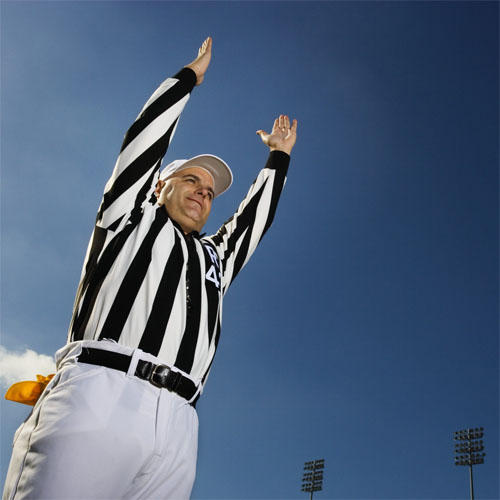
Zebra
Somewhere in, NJ
Male, 62
I've officiated football for over 30 years, now in my 26th on the college level. I've worked NCAA playoffs at the Division II and III level. In addition, I've coached at the scholastic level and have been an educator for over 35 years. I have no interest whatsoever in being an NFL official! Ever!
Odd question. Most of our equipment is simply clothing. Good shoes help. But the most important thing you take onto the field is your brain.
Share Answer: 

A RB stiff arming usually is pushing away the defender. It is not the upward stretching/straining motion that you're talking about with OLs. If a RB were to grab the facemask and twist or hold onto it, then you have a foul.
Share Answer: 
That's a TD for B. A2 gets disqualified for the swing - contact isn't necessary. Enforce penalty on the try.
Share Answer: 
There are several scenarios to what you ask. If a ball carrier's helmet comes off, the play is dead immediately. That's a safety issue. If anyone else's helmet comes off, they have an opportunity to step away and not participate; the play goes on. If a player's helmet comes off and he is already engaged (making a play on the runner, in process of making a block) he may continue. If a player's helmet comes off, he may not continue to play (beyond a step or two) or it is a personal foul.
Share Answer: 
Nurse Practitioner
 As gender roles continue to evolve, are you seeing a rise in the % of male nurses?
Election Inspector
 Do most poll staffers agree that the ballots are REALLY confusing?
Bar Mitzvah DJ
 What's the craziest thing you've seen at a bar mitzvah?
Yes. Within limits. He cannot be moving forward at the time of the snap. Everyone must have come to a complete stop before he starts to move sideways. But, the basic answer is, yes.
Share Answer: 
To the best of my knowledge, only in college can you run back a missed 2 pt conversion as you describe. In college, that is a safety.
Share Answer: 
If he starts jogging downfield, you could consider it a delay of game foul. But that's sort of a stretch. Unless there's some exigent circumstance that I can't figure out, the receiver is creating a false start. That also assumes that the team is pretty much ready to snap the ball - he's on the wrong side of the ball. If a receiver is too far up, an official - the linesman or line judge - might tell him to "watch the ball" and let him correct himself. But the receiver doesn't seem too sharp.
Share Answer: 
-OR-
 Login with Facebook
 (max 20 characters - letters, numbers, and underscores only. Note that your username is private, and you have the option to choose an alias when asking questions or hosting a Q&A.)
(A valid e-mail address is required. Your e-mail will not be shared with anyone.)
(min 5 characters)
By checking this box, you acknowledge that you have read and agree to Jobstr.com’s Terms and Privacy Policy.
-OR-
Register with Facebook(Don't worry: you'll be able to choose an alias when asking questions or hosting a Q&A.)



 Browse Jobs
 Host a Q&A
 Search

 Submit Your Question
 Host a Q&A
 Last 7

