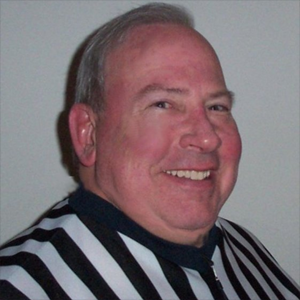
Rndballref
20 Years Experience
Chicago, IL
Male, 60
For twenty years I officiated high school, AAU and park district basketball games, retiring recently. For a few officiating is the focus of their occupation, while for most working as an umpire or basketball referee is an avocation. I started ref'ing to earn beer money during college, but it became a great way to stay connected to the best sports game in the universe. As a spinoff, I wrote a sports-thriller novel loosely based on my referee experiences titled, Advantage Disadvantage
Depends where you are. If you live in a small town you will probably be the best in your class. Around Chicago and its suburbs, there are more important measurements: speed, height, jump shot form, fundamentals, basketball IQ, etc.. The basketball landscape is littered with players who dominated in 8th grade but didn't grow in height, skills or athleticism. There is a great book about one such player, Play Their Hearts Out, which chronicles the true story of Dimetrius Walker. Once, he was a sure fire next LeBron, but in high school he stopped growing and now is a bench guard in college. Be humble, and forget the scoring stats - my best advice is work on your fundamentals.
Share Answer: 

Yes, in the definition section of the rule book it states that "during an interrupted dribble the out bounds provision does not apply". So a player can step out of bounds and come back in and resume a dribble or pick the ball up, as long as stepping out of bounds was unintentional. In high school going out of bounds purposely is a violation, in college it is a technical, and in the NBA there is no prohibition.
Share Answer: 
Not at all. I am biased toward the Big Ten so I went down with Wisconsin already in the 1st round. My beloved Illini nearly lost to Colorado State too. My best pick so far this year is California over UNLV, but generally I am middle of the pack. How about you?
Share Answer: 
1) For most officials, the block/charge is the toughest because the action happens so quickly and to really get the call right, the official should not be looking at the dribbler (ref's would say, officiate the defense). It's natural to watch the offense, but a clear, solid call happens when the official focuses on the defense. 2) for young refs it is striking the balance between being an over the top tough guy vs getting walked on for being weak. 3) especially at the lower levels, deciding what not to call is hard to learn - my generalization is that new refs overcall violations and are reluctant to call fouls.
Share Answer: 
Nurse Practitioner
 Could a nurse practitioner do the job of a primary care physician?
EMT
 What was the most gruesome trauma you witnessed while on the job?
Hotel Travel Blog Active 2019
 What do you do if a guest is doing something illegal in a room?
If you shoot a jump shot and someone touches your waist, it normally disrupts the flow of your shot, and therefore should generally be called. BUT, this calls for your judgement - if you think the touching causes the shooter to alter the rhythm of his shot then call a handcheck. Other than in a shooting situation, I suggest these guidelines for calling a handcheck: foul if 1) the handcheck dislodges the dribbler or postplayer, or 2) the handpressure is constant on a moving opponent.
Share Answer: 
If the player was pushed it should be a foul. If the player was not pushed, it is traveling when they hold the ball and any part of the body hits the floor beside the hands or feet.
Probably the right call is a late-called foul. It seems wrong to penalize the offensive player when the defender started the problem.
Share Answer: 
The officials NEVER remain at the scorers table. Directly from the NFHS rulebook: The official scorebook shall remain at the scorers table througout the game, including all intermissions. Note, it says the official scorebook, not the official.
Share Answer: 
-OR-
 Login with Facebook
 (max 20 characters - letters, numbers, and underscores only. Note that your username is private, and you have the option to choose an alias when asking questions or hosting a Q&A.)
(A valid e-mail address is required. Your e-mail will not be shared with anyone.)
(min 5 characters)
By checking this box, you acknowledge that you have read and agree to Jobstr.com’s Terms and Privacy Policy.
-OR-
Register with Facebook(Don't worry: you'll be able to choose an alias when asking questions or hosting a Q&A.)



 Browse Jobs
 Host a Q&A
 Search

 Submit Your Question
 Host a Q&A
 Last 7

