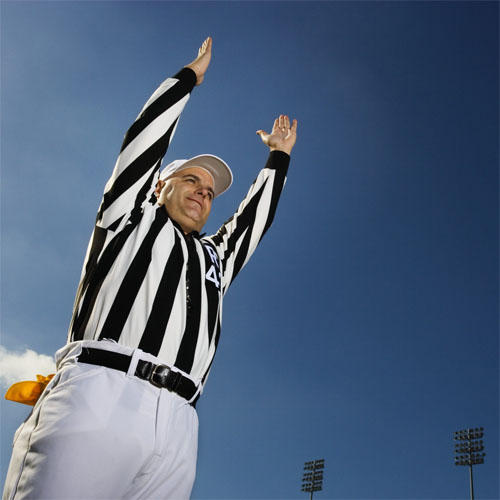
Zebra
Somewhere in, NJ
Male, 62
I've officiated football for over 30 years, now in my 26th on the college level. I've worked NCAA playoffs at the Division II and III level. In addition, I've coached at the scholastic level and have been an educator for over 35 years. I have no interest whatsoever in being an NFL official! Ever!
Good question. Are you an Ohio State or Michigan fan? The philosophy officials often use is "advantage/disadvantage". Did the action have a material impact on the play? Having an arm around a receiver isn't automatically a foul. Did the arm actually hook or grab the receiver and turn him away from the ball, or prevent him from reaching for the ball? Or was the arm being there just a good play, timed right? The rules today at virtually all levels - but especially the NFL - favor offense. So I return to the earlier point: Did the action have a material impact on the play? If yes, then we have a foul. And that's why those deep officials get the big bucks - for their judgment on that play.
Share Answer: 

Your question is a little confusing but let me try.
When a runner goes out of bounds, the ball is spotted where the ball crosses the OOB line, not the runner. It's pretty straight forward and not that difficult to officiate.
I'm not quite sure what the second part of your question means, but here goes. The ball isn't out of bounds until it touches something out of bounds. A player in the field of play is not OOB. So if a player reaches out and catches a ball that has crossed the sideline - and he is still in bounds - the ball is still in play and it's a catch.
Share Answer: 
I answered this one above but.....
If the ball touches anything that's out of bounds, the ball is out of bounds. Therefore if the player is out of bounds - or straddling the line - then the ball is a kick out of bounds and a foul against the kicking team.
Share Answer: 
I don't know what the NFL allows in that regard. The "Lambeau Leap" has been accepted for quite a while. That mat play into the decision.
Share Answer: 
Nail Technician
 How sanitary are the pedicure basins really?
Literary Scout
 Can a novelist achieve huge success through self-publishing?
Car Salesman
 Are women more likely to get taken advantage of when buying a car?
Yes. Unless something else happens that isn't described here, it was the offense that put the ball in its own end zone. If it goes out, it's their responsibility. If they recover it there, it's a safety. And if the defense recovers, it's a touchdown
Share Answer: 
Sorry, this isn't a trivia or history site.
Share Answer: 
If a pass does not cross the line of scrimmage (screen) then a) you can't have ineligibles down field and b) you can't have pass interference (offense or defense). In the NFL, they are tighter with lineman, only giving them a yard downfield to block on passes behind the LOS. So, yes, receivers downfield can block before the pass is thrown as long as the pass was caught behind the LOS.
Share Answer: 
-OR-
 Login with Facebook
 (max 20 characters - letters, numbers, and underscores only. Note that your username is private, and you have the option to choose an alias when asking questions or hosting a Q&A.)
(A valid e-mail address is required. Your e-mail will not be shared with anyone.)
(min 5 characters)
By checking this box, you acknowledge that you have read and agree to Jobstr.com’s Terms and Privacy Policy.
-OR-
Register with Facebook(Don't worry: you'll be able to choose an alias when asking questions or hosting a Q&A.)



 Browse Jobs
 Host a Q&A
 Search

 Submit Your Question
 Host a Q&A
 Last 7

