In a three man crew, usually the Center official and the Trail official will both see it. One of them has primary coverage and has to make the initial call. The other can come in and discuss if they see it a different way, but someone has to make the initial call, and in a normal set the on-ball ref should be able to see the line and the feet. In general, I try not to call something I did not see, but 2 or 3 point shots force you to call - a no call 3 is a defacto 2. I suppose if you struggle to know and it is your call, you should call a 2, then conference with your partners to see if they can offer you better guidence.
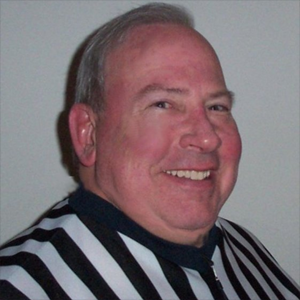
Basketball Referee
| Name: | Rndballref |
| Location: | Chicago, IL |
| Gender: | M |
| Age: | 58 |
The fans pay for the best players to be on the floor. If you allow rough play and don't penalize it, then why not add a "goon" (ala hockey of old) to knock the stars out of the contest. The NBA surely looks at superstars as assets which generate revenue, so I agree with being harsh with hurtful play.
Yes, it is often unfair that a coach's actions can influence or cost their team a game, but it is also unfair that a coach can use the referees and a T to motivate his team. I had a coach draw me closer and quietly tell me that he wanted a T. I wouldn't call it, so then he stepped back and ultimately swore at me, earning him the T. Then his team turned on the juice and blew the other team out. So, I guess it goes both ways.
If the clock started when the ball crossed into the court, a team could stall, for example, by throwing the ball high in the air across the gym and out of bounds without any player having a chance to catch the ball. Or, from the front court on an out of bounds play you could pitch the ball into the backcourt and stall off a few seconds, without any player touching the ball. The clock rightfully starts when an in-bounds player touches the ball.
I am a big fan of college basketball. I was really disgusted when D Wade and Bosh and LeBron conspired to rig Miami's team, which circumvented the whole basis for creating competition in the NBA - each team owner acting in their own interest in the market for players. There is a real danger for this precedent - what if in the future a group of free agent all stars decide to play for a team a rack up a record of say, 75 - 7. Who would watch the games? When Jordan had his 2nd run on the Bulls, the stadium often emptied out in the third quarter - just before the fat lady sang. In general I find the NBA, especially in the eastern conference too physical. Although I must admit it is fun to watch the D Rose and the Bulls (I probably like them because they don't have a center-oriented offense. ...More
As far as I know there is no mechanic for overturning calls officially except in state tournaments where replay might be allowed for end of quarter timing calls (before or after buzzer), with the exception of 5 correctable errors as defined in the federation rule book. These 5 errors are things like reversing an erroneously awarded free throw, etc.. In all other cases overturning calls should be discussed in the referee's pregame in the lockerroom. Some guys take the position that they never want to be overturned. My preference, and I always told my partners this, is if my partner disagrees with my call do the following: 1) blow the whistle and stop the game, 2) privately tell me what you saw and why you disagree with the call, and 3) I will decide whether to overturn based on what I saw ...More
Shannon Brown is the most famous player on the court when I officiated when he played at Proviso East High School.
Parents are the problem with youth sports. I have had more parents removed from games than players and coaches combined. Here's an irony: freshman games are harder to call than varsity, because unless you want to ruin the game completely in underclass games you are deciding when not to blow the whistle. in varsity games you call mostly what you see. Yet, as you progress and hone the referee craft you work less underclass games. So inevitably in a blowout freshman game a player is mildy fouled while dribbling going east and west near the half court line. The dribbler maintains control of the ball, but you are trying to keep the game moving. The freshman's father stands up screaming for a foul, because he wants his 3rd string kid to shoot a free throw to get it on tape and in the record ...More
A troublesome judgement call is whether a foul, typically near the end of a game, is intentional or not. The whole gym knows that a team wants to foul to stop the clock in a tight game but for some officials, if the defender is "going for the ball" no intentional foul is called. Intentional fouls carry a higher penalty in National Federation High School Rules. So it is called inconsistently. A potential rule change is instead of penalizing free throws and the ball, I would make the penalty free throws OR the ball.
Two things: 1) fans often mistake legitimate basketball moves when the player goes slowly - especially when a player down low pivots, steps and lifts the pivot foot. This is a legitimate basket move (otherwise you would never be able to shoot a layup). 2) The call most missed (maybe it is just my pet peeve) is the Jordan move of giving up your pivot foot before starting your dribble. This gives a tremendous advantage to the offensive player, and is very difficult to defend.
I saw a 6 foot freshman dunk in the middle of the 4th quarter in a tight game. It was shocking.
I have thick skin, and in twenty years I have tossed maybe 2 players (more coaches for sure!). I have always looked at like this: If a player disagrees and argues with a call I will not T him up, especially if the player approaches with respect. And I will always explain my call even if I have booted it. What can never be tolerated is any personal attack, which usually is designed to intimidate the ref. More than anything a player's actions after a close call does determine how you view the player on the next one (we are just human). The tougher situation when you have to be calm is when a player deliberately acts to show you up - some refs automatically T a player, but I feel like that is putting your ego in front of the game.
I once passed on a block/charge situation because I thought it was one of my partner's call. I was wrong and it was mine to make. So, nothing was called even when the players went sprawling. Both coaches were pissed, and were right. There was a foul in there, and a no call was horrible. By the way, some of my best calls were no calls, even when the crowd howls for something. I am so conscious of not coming back with a make-up call that I think I overcompensate and dig in to the detriment of the team whose call I booted.
In most high schools (at least around Chicago) the coaches usually will not put up with such selfish play....BUT in AAU ball, where a lot of college recruiters have to go to get talent, the desire for the highlight reel is rampant and lessens the game. At the very elite level AAU players are better developed through rigorous training and coaching, but the street agent and coach-controlled hold on middle to upper players is horrible. Some AAU coaches encourage showboating because it is flashy and might increase the recruiting clout that they show, but it usually does not win games. It is a real dilemma.
Offensive goaltending is the act of interfering with the ball in its downward arc toward the basket or interfering with the ball while it is in an imaginary cylinder above the rim. When I was in high school college and HS players were not allowed to dunk. I think that the rule makers have decided that it is an exciting play for fans, and it does not happen in excess in games. The tough call is when the ball bounces on the rim and a player slams it in. Did the player touch the ball while it was inside that cylinder?
A player chest bumped my partner and nearly knocked him over. On the way down, he threw the player out.
It is absolutely not a legal play to use a teammate or an opponent to leverage a jump. By the way, a couple years ago players started showing up with shoes that had built-in springs in the heels - also illegal.
No, I never officiated a game where there was any legal betting.There were anecdotal stories and rumors about betting on high school games, but I don't have first hand knowledge. Here is a story told to me which I have every reason to believe is true, and it also served as the inspiration for my novel's storyline: A ref was called the night before to fill in for a park district game in Chicago. He was going to be paid $100 to be the only official (high game fee should have raised a red flag). He showed up and there were a couple hundred people surrounding the outdoor court in a park. Two huge guys from opposing gangs met the ref at his car and explained that they were there to protect him ("no quips") no matter what his calls were. The pressure level was raised and the ref was worried. ...More
In high school ball (and even college) the girls game is played below the rim. So, there is generally more passing and bombing away compared to the boy's game. Having said that, there is an unmistakable trend in the girl's game where the guards can handle the ball and are skilled enough to penetrate the lane and dish. In my view, the most boring basketball (boys, girls, mens or women) is when they dump the ball into the post and watch a turnaround jump shot by tall players. If you lower the girl's rim (ring as the rule book calls it), I'm afraid you will encourage more rough post play. Just my opinion though, because there are plenty of people who loved watching Shaq play.
The National Federation of High Schools revises the rules annually. The last most significant rule change (in my opinion) was implemented a couple years ago. Before the change, when a player with the ball committed a foul it was an offensive foul. Likewise, before the change, if a player on the offensive team WITHOUT the ball committed a foul it was considered a common foul and if the other team was in the bonus free throws were attempted. When they changed the rule they added a foul type (offensive team foul) and it is penalized like a player control foul - no free throws.
Most changes to the rule book are "points of emphasis" or mechanic changes. It seems rough post play and hand-checking are annual points of emphasis. An example of a mechanics change was made several years ago so ...More
There are some sports where it is difficult to officiate if you have not played (wrestling, diving, gymnastics). In my view basketball is not one of them, although people with playing experience often excel.
Every state is different, but here's how it goes in Illinois: you apply to the state to get certified. In the application you attest to your non-criminal background, and you list 3 references, one of whom should be associated with high school basketball. You send in your application and $40 and they will send reference cards (probably emails by now) to your three people. Once they respond in a satisfactory way, then you are sent the rule, case study and mechanics books and the questions for an open book exam. In Illinois you also have to attend an annual rules meeting (now online). ...More If you want to work the state tournament you must attend a certified camp at least every three years. I wish I would have attended camps early in my career - they are humbling and usually stress judgement and proper mechanics but you learn so much.
Having done all of this you will be "patched", that is you've passed the state requirements and they send you the state's patch to sew on your uniform. This is half the battle. Now you must get booked for assignments, usually starting out doing freshman games. In most states, it is worth it to join a local official's association. Not only will you get valuable training at the meetings from the veterans, usually each association also has assignment chairpersons who come to the meetings and are members. They often give favorable treatment to members of their associations in terms of game assignments. Some of these associations offer mentoring programs where experienced officials will watch you work games and offer critical feedback. In the summer camps you will also get great feedback from the refs running the camp. Sometimes they will shadow you on the floor, helping you with positioning, angles, and mechanics. It all sounds like a lot, but if you love the game like I do, officiating is a wonderful way of staying connected long after your playing days are over - and they will even pay you for it!
If you want to work the state tournament you must attend a certified camp at least every three years. I wish I would have attended camps early in my career - they are humbling and usually stress judgement and proper mechanics but you learn so much.
Having done all of this you will be "patched", that is you've passed the state requirements and they send you the state's patch to sew on your uniform. This is half the battle. Now you must get booked for assignments, usually starting out doing freshman games. In most states, it is worth it to join a local official's association. Not only will you get valuable training at the meetings from the veterans, usually each association also has assignment chairpersons who come to the meetings and are members. They often give favorable treatment to members of their associations in terms of game assignments. Some of these associations offer mentoring programs where experienced officials will watch you work games and offer critical feedback. In the summer camps you will also get great feedback from the refs running the camp. Sometimes they will shadow you on the floor, helping you with positioning, angles, and mechanics. It all sounds like a lot, but if you love the game like I do, officiating is a wonderful way of staying connected long after your playing days are over - and they will even pay you for it!
First, the rule. Your position on the court is based on where you stood (or touched last). So after a rebound a player establishes himself out of bounds (one foot or two), and then lifts a foot through an imaginary plane along the baseline, he is not inbounds until his foot hits the floor inbounds - no violation for breaking the plane by the player throwing in the ball.
Secondly, there is the dominent philosophy of basket officating called, "Advantage Disadvantage" which holds that you should only stop the game if an opposing player caused a change in A/D. So, you pass on uncontested palming in the backcourt for example.
Yes, a coach once said, "you wouldn't let it get so rough if the player wasn't black". I immediately blew my whistle and told the coach he was out of bounds. If he wants to say that it is getting rough in there, then say so. But to suggest that it is rough because the post player was black was an attack on my integrity. I gave him a chance to rescind his comment (remember, I rarely use technical fouls), and he immediately agreed that it was inappropriate and inaccurate - he apologized. More often in my experience there has been racial trash talk between players which must be immediately penalized. A few years ago a school's student body was taunting a black player with a racial chant. The referees failed to stop the game, warn the crowd, and if necessary start having them removed. The ...More
No one has ever offered me a bribe. Darn!
In most states, each game is supposed to have a function designated game management (or game administrator). This is usually the Athletic Director. So, when a fan needs to be ejected the referee should find the game administrator and say something like, "the guy in the third row with the red shirt must be ejected." In my experience, they always remove the fan as requested. In summary, I have required certain fans to be ejected, but I've never had to physically do it or have a standoff with a fan. If the game management refused to eject a fan, I would refuse to continue ref'ing the game.
I admit it during a game if I boot a call. Most coaches would favor honesty as in, "hey coach you are probably right about that last call - after thinking about it I think I made the wrong call", as opposed to trying to argue something you realize is not true. So if there was a question of rule or angle of play, and if I determined that I made a bad call or applied a rule in error I would definitely contact the coach and explain what my thinking was, and why I now think I may have been wrong. That's me, other ref's never ever say they made a bad call.
The ref is part of the floor. If the ball bounces off a ref, it is ruled based on where the ref is standing. If the ref is standing one foot out of bounds and player causes the ball to hit the ref it is ruled out of bounds (even if the ball never crossed the line). Likewise if the ref is legally in bounds and the ball hits him, play on. Think hockey.
It is hard to get a charge because to play proper defense in order to get a charge is hard work. Remember, the defender must establish his position BEFORE the offensive player leaves his feet. And to further complicate things, the defender can be moving while taking a charge if the defender moves "obliquely" after establishing a position. Here's my opinion: the best referees get the block/charge correct most often because they "referee the defense". That means, for example, if you are the lead referee under the basket and a player begins to drive, shift your eyes immediately to watch the defender. By following the defender, you will know whether he got there in time. Refereeing the defense is hard to do because we always watch the offense (on TV and at games). Next time you watch a game, ...More
For the past 5 years my schedule was about 75% girls' games. The game is played below the rim with a focus on passing. Every year I think the girls' games improve in quality on the high school level. Most teams around Chicago have a guard who can penetrate the lane, and a 3 point shooter. What they never have are quick forwards who have inside games. To me, the girl's high school and college games are intersting, but I do not enjoy the women's pro game. It seems like a WMCA pickup game. The girls game will continue to get better, but it won't be the high flying athletic boys game at comparable levels.
An "over and back", or backcourt violation (not to be confused with a 10 second backcourt violation) can only occur when it is proceeded by the offensive team establishing possession in their front court. There is no possession on a throw in, which is why the offense can pitch it directly into the backcourt. In your scenario, there is a judgement call to be made: did the offensive player in a controlled way purposely tip the ball (implying control)? Or did the player tip the ball without control? Without control, it is not a backcourt violation to retrieve it.
if any part of a player is out of bounds, he is out of bounds. If a player (a teammate who is legally in the game as a participant) is out of bounds and is the first to touch the ball before it is otherwise out of bounds, the ball is awarded to the other team.
Here's a better example to clarify: Player A1 is out of bounds throwing the ball in. The ball bounces off of B1 (who is inbounds) and comes back and hits A1 before A1 returns to be inbounds. Team B is awarded a throw in.
Completely unacceptable. If I was the coach I would lodge my complaint with the referees as soon as it started getting rough. If they continued to fail to enforce the legitimate rules of the game I would be compelled to act. I believe that a coach’s first responsibility is the safety of the players, and if I felt that the team’s safety was at risk I would pull my players off the floor and forfeit the match. Then I would write a commentary along with game tape and get the referees bounced (and decertified) for 1) not enforcing the rules of the game and 2) allowing the environment to threaten the safety of the players. It is hard to believe that state certified officials would let this happen - it is also strange to hear about 3 man crews working middle school games. In the conferences I ...More
Just a speculative guess... I think the boys high school team beats the women's pro team because usually the best boys' team sends a player or two right into the NBA. Males peak physically around 19 or twenty, so I think physicality trumps maturity and practice. Who knows? This question reminds me of the tennis battle of the sexes in 1973 when Bobby Riggs gave Billie Jean King the doubles lines and was soundly trounced (but both made a lot money promoting it!).
If a player shoots at the other teams basket & one of his teammates swats the ball away as it is about to enter the basket, is that goal tending? 2pts for opps?
A shooting foul is defined as a player on a try or tip at his team's basket. So, if a player is fouled shooting at the "wrong" basket it is a common foul.
If the ball is in the cylinder and batted away by the defensive team it is goaltending and 2 points.
A player throwing the ball in on a spot throw in is restricted to a 3 foot wide, and unlimited deep area. At least one foot must be in or on this area. There is no travelling possible on a throw in. Now, to your question, a throw in player is allowed to dribble as long as the dribbling is out of bounds. Hypothetically if the throw in player dribles in bounds and then touches the ball it is a turnover because the throw in player was out of bounds and touched the ball which was put in bounds when the dribble hit the playing floor. If the throw in is after a basket, of course there is no 3 foot wide area.
The ball is dead when it is apparent to the referee that it will not hit the rim or enter the ring. I wouldn't think that any reasonable official would whistle a lane violation, ruling that it occurred before the free throw was dead. I have never seen it, and if one of my partners called that it would seem like he is trying to pick a fight or punish one team. The only exception would be if the other team steps into the lane (well before the shot is launched) to purposely disconcert the free thrower and he fires an air ball, then I suppose a violation could be called.
Replay IS being used by various levels in basketball. In National Federation of High School Rules, states are allowed the option to use replay in the state tournament for specific things such as whether a buzzer shot was launched before time expired. In college, they use replay to ascertain the severity of fouls - whether a tech foul is flagarant or class 1, etc. NBA seems to use it more. The benefit is to make sure you get the call correct, the obvious downside is that it takes time and breaks momentum.
Pro, college men, college women and high school rules sometime are different so I'm only addressing high school rules.I believe this situation was addressed in a recent case book for the NFHS (national federation of high schools). As I recall, the case book interpretation was that playing with too many players was punishable ONLY if discovered during a live ball. As you have described it, I believe the technical foul was called in error. Furthermore, strong referees would always count players after substitutes come in and/or after timeouts, especially at the varsity level with a three man crew. Preventive officiating would have at least one of the crew always count the players. You will notice this watching a seasoned good crew, as the official administering the throw-in, free throws, ...More
There needs to be more women referees at all levels. In the conferences I worked in there was a fair amount of pressure on the assignment chairs to put qualified women at the varsity level. However, I observed that at clinics and in associations which form the pools of available referees, the participants were predominantly men. So when a talented female referee was "discovered", my experience is that the path to college assignments (mentoring, camps, and connections) opened up quickly for them. In my view, there is not enough emphasis on recruiting and mentoring early on, and so the pool is drained of quality female talent quickly. For anyone to move ahead in your officiating career you have to be solid in rules knowledge, judgement, hustle, etc, but now is a great time for ...More
In Illinois, the only fine I am aware of is included in most game assignment contracts which is equal to one game fee. So, if you fail to show up at an assigned game you could be fined the amount you would have been paid. As far as I know, there are no fines for making bad calls. Eventually, if you have complaints from the coaches, the assignments dry up quickly. I'm not sure about college, but I suspect suspensions are possible in the NBA and that is equivalent to being fined.
The answer to your question is no. If the previous award was in error, it was either correctable or uncorrectable depending on when it was discovered. If the second foul still does not put you in the bonus you should not be awarded any free throws. The fact that a mistake was made on the previous free foul does not mandate a second mistake (assuming both of these fouls occurred with less than 7 team fouls).
Based on your scenario this should not have been called a "T". Remember it is a technical foul to have more than 5 players on the floor DURING A LIVE BALL. In your description the ball never changed status to live because on a throw in the ball is only considered live when "it is put at the disposal of the team who will execute the throw in". Your ref made an error.
Every state has its own rules. In Illinois you have to be at least 17 years old to be "patched" by the state. You must be patched by the state to work high school games. However, many park districts and youth clubs hire younger officials to work games. Some of them also offer training and mentoring of young teenagers.
Recently, as reported on ESPN, in a girls JH/JV game a field goal attempt was thrown from 3/4 court, bounced on the floor and went in. 2 or 3 pt. goal? Why?
thank you
A try or tap ends when it is apparent that the ball will not go through the ring. So when a 3 point try falls short and the ball bounces on the floor the try is over. When a ball enters the ring and goes through (assuming it is no longer a 3 point try) it is a two point score.
I try not to, but it happens. If a player challenges me I won't back down even in a big game. Being perceived as a punk player can only work to your detriment.
A referee should not favor any team, but officials are only human. I think perceptions are the issue here. For example, urban Chicago teams tend to play high paced running and pressing games, while suburban teams tend to play more patterned offenses (stereotypical, I know, but generally true). So when an urban teams plays in the suburbs they might encounter referees who are used to calling a slower paced game with tighter calls, while Chicago refs might allow more contact. So, do the suburban officials favor suburban teams, or are they just used to that style of play? In theory, a foul is a foul, but all of us have degrees of what we don't call (see advantage disadvantage theory of officiating). However, if you find a referee who clearly favors a team (not style), he or she must ...More
The only exception to 2 free throws being awarded in the NBA that I know of is in the last two minutes of the game it is 1 free throw plus possession. There is a good chart of NBA free throws on Wikipedia: http://en.wikipedia.org/wiki/Free_throw So who knows what the announcers are saying? They also say that some fouls are "over the back" and others are "reaching in", neither of which are defined in the rule book.
If the ball goes directly from inbounds to touch Team A's player (before hitting the floor) who is out of bounds the ball is awarded to Team B. It doesn't matter who tipped the ball before the ball went out of bounds. The violation is that Player A touched a live, inbounds ball while he/she was out of bounds.
I only called technical fouls on players for swearing when it was aimed at an opposing player or me. A push or shove can be a either common, intentional, or technical foul depending on the severity and situation.
It depends on how they approach and ask the question.
This was asked by steve w in his June, 2012 questions. Here is the answer I gave him:
First, the rule. Your position on the court is based on where you stood (or touched last). So after a rebound a player establishes himself out of bounds (one foot or two), and then lifts a foot through an imaginary plane along the baseline, he is not inbounds until his foot hits the floor inbounds - no violation for breaking the plane by the player throwing in the ball.
Secondly, there is the dominent philosophy of basket officating called, "Advantage Disadvantage" which holds that you should only stop the game if an opposing player caused a change in A/D. So, you pass on uncontested palming in the backcourt for example.
I assume you are a player. I always respected the players who accepted violations and fouls I called on them, and when they had a question they respectfully asked about the call (not argued). Have you ever seen on tv a college ref who makes a marginal call that the player disagrees with, the ref gives the player an explanation and the player accepts the call (such as patting the ref on the back, or saying "good call"). Another way to earn the ref's respect is to control your teammates when they think there is a bad call. This is all common sense - I guess I am saying respect the refs first and it will come back to you.
To clarify your question, I believe you are asking what should happen if a one and one is awarded in error and then discovered. There are 5 correctable errors in the high school federation rule book, and one is the awarding of unmerited free throws. However, to be correctable, it must be recognized by the officials no later than during the first dead ball, after the clock has been properly started. I have encountered this only once in 20 years, If properly recognized, the free throw points are removed but other scores after the erroneous last free throw still count. It's a messy rule, and once every twenty years is too much!
This is a tough judgement call. If, both boys simultaneously held the ball or put force on the ball in opposite directions (as in a stuffed blocked shot) then it should be called a held ball (jump ball going to the possession arrow). If the ref rules that there was not dual possession then you have to call a foul and/or subject a player to really getting hurt. This does not happen too often at the boy's varsity level (quick and strength), but it happens. Opinion: good officials have a quick whistle for held balls to avoid the weaker player always getting a foul.
No you don't get the points. The referees should stop the game once they realize the game is being played in the wrong directions. Points made, stand. Turn the teams around, and the refs should be incredibly embarrassed. This is very simple. The home teams picks which bench they want to use before the game. Each team scores at the basket opposite of their benches in the first half. Bad officiating - whether it is a two or three person crew someone should have caught it DURING THE WARMUPS!
I think the end of close game calls are debatable, especially by the coaches who have a vested interest. From the beginning, I have been confident enough to be strong in my calls and my judgement. Here's what happened in one instance: The lead changed hands 3 times in the last minute. With 3 seconds left and the game tied, I am administering a throw in to the home team near their basket on the end line. After a time out, the home team lobs over the defender and the offensive player skips toward the basket after dribbling once and picking up the ball. I blow met whistle loudly while the ball is in the air, and I am waiving off the shot (the buzzer sounds while the ball is in the air as well). I move in and call traveling and I am waiving off the shot, sending the game into overtime. The home ...More
There is great debate here about whether you should call every infraction, or should you call violations and infractions only if there is a change in advantage? I personally believe that it is better to use the Advantage/Disadvantage considerations at the lower levels where the skill set is more limited. If, in a freshman game you call everything you will most assuredly ruin the flow of basketball and probably foul out most of the starters. At the varsity level, or college there is less to NOT CALL. Mark Cuban, owner of the NBA Dallas Mavericks is strongly against Advantage/Disadvantage officiating in the NBA. Juries out, and every official I know has a different take on this (and so do the coaches).
I have never seen that, but I would administer as follows: I would not allow a disqualified player to shoot the free throws. Since free throws are administered in the order the fouls were committed, 1) bring in the sub, 2) the sub shoots the free throws awarded o the fouled out player, 3) team b shoots the technical fouls, 4) team b gets the ball at half court.
Some international games are played without referees touching the ball on violations, as you suggest. I guess it rewards readiness but also creates a sneakiness to the game. As it is played in high school federation rules, the referees should hold the ball allowing substitutes and the teams are given time to setup. I suppose it is a matter of preference.
In National Federation High School rules each technical is awarded 2 free throws, except if there are off-setting technicals on both teams. Remember a coach can be tossed on 1 technical for a flagrant behavior, for two direct technicals or 3 indirect/directs. In your question the team would be awarded 4 free throws plus the ball.
The NFHS rules were changed for the 2011/12 season to rule that during a throw-in by team A, team A has ball control when the ball for the throw in is at their disposal. So if your team commits a team foul during control it is team control foul and no free throws are rewarded. Exception: if the push is considered flagarant.
Since the defender hit the ball, the offensive team no longer has control of the ball, nor did they gain control when it grazed the offensive player. So, no possession right before the ball entered the backcourt, no backcourt violation . Bad call, ref.
Yes, because Team A established control in the front court and then Team A touched the ball in the backcourt without Team B gaining possession it is a backcourt violation.
A defender has the right to a vertical space if he gets there before the offensive leaves his space to move. Therefore, a defender can be moving and still take a charge. The rule book calls this moving obliquely - that is away or angled. If an offensive player turns into a space the defender is entitled to, it is a charge.
I think this is the same question you asked 2 questions above. The answer is that unless it is a flagrant (technical) foul, the push is considered a team control foul. No free throws are awarded to team B, but they are awarded the ball at the point nearest the infraction.
In theory, a foul is a foul is a foul. If the leading team commits a foul late in the game that I would have called in the first half, I would call it in the last 20 seconds. My experience is the opposite. Unless there is a crushing foul many (unprincipled) refs will eat the whistle to avoid possible overtime. That's bad, but worse is calling a foul late in the game that had been ignorred earlier in the game.
No. There is no provision for a non-participating official to over rule a referee. If I was watching a couple officials work a game I would not get involved during live play unless the game was devolving into mayhem. Normally, I would go to the official's lockerroom at halftime and discuss what they saw, what the rule interpertation should be, and how to administer it, but not during the game unless it was totally out of control. Except in unusual situations, there is no provision for one referee on the floor to over rule the other. My preference always is that if one of my partners believe I blew a call I want him to approach me and tell me what he saw, and let me decide to change my call. I used to cover this style in my pre-game conference with the ...More
An airborne shooter is defined in the high school rule book as an offensive player who has released the shot but has not returned to the floor. An airborne shooter is considered to be in the act of shooting. If a defender interfers with a shooter's follow through, it is a foul unless the offensive player's arm breaks through the defenders vertical space. In summary if the defender stops a shooter's follow through in the shooter's vertical space, a shooting foul should be called.
There is nothing in the Ferderation of High School rule book, but common sense should prevail. Most assignment chairpersons around here ask if you are connected in some way to a school, and they try to avoid booking conflicts such as hiring a referee at the school where they teach. In Illinois when you make your dates available to work the state tourney you can exclude schools you are connected to.
If you get a timeout before 10 seconds is called, the 10 seconds is reset. Just as on a throw-in gets reset to 5 on a timeout. Only the shot clock stays where it was on a time out.
The ball is NOT out of bounds when it crosses the imaginary plane above the sidelines or end lines. The ball is out of bounds when it touches an object or player or other person who is out of bounds. So if Team A's player leaps in the air from in bounds, crosses thru the imaginary boundary in the air and does not touch anything and saves the ball by hitting onto a Team B player who is standing out of bounds, the ball should be awarded to Team A.
However, if Team A's player is the last to touch the ball before it hits something out of bounds beside a player on Team B (such as the bleachers, or an out bounds referee, or the bench, or the part of the floor which is out of bounds), then Team B gets the ball.
Merely asking for timeout when your team does not have possession is not a technical foul, UNLESS it is done in a purposeful, unsportsmanlike manner. So if you ask for the timeout in the way you normally ask, the referee should ignore you, and better yet say something like "no timeout, you don't have possession". If my judgement was that the coach was trying to get an advantage, such as an erroneous whistle (to get a sub in for instance, or give his players a short rest), or to distract the officials from the game then I would call an unsportsmanlike technical. Having said all of that, I have never called a T on a coach for asking for a timeout without ball possession.
Football??? In Federation rules for basketball, you must start the game with five players. If, because of disqualification or injuries you lose players, you can continue to play as long as you have at least 2 players. If you had only one player, how would you inbound a throw in? So, you must start with five per side, but after the game begins you can play with at least 2.
Not at all. I am biased toward the Big Ten so I went down with Wisconsin already in the 1st round. My beloved Illini nearly lost to Colorado State too. My best pick so far this year is California over UNLV, but generally I am middle of the pack. How about you?
I really don't watch enough NBA basketball to form an opinion. I know there is a lot of negative chatter about Joey Crawford. The all-time worst has got to be Tim Donaghy who disgraced the profession and went to prison for his misconduct. There is a website which keeps statistics on NBA refs - do you believe that? They track how many fouls, techs, etc. each referee calls. You can kind of tell who the league respects by their designation (main vs crew) and also how many games each has worked. Here's the website: www.nbastuffer.com/referee_stats
A foul committed after the ball is "dead" is ignored by rule book unless it is flagrant or intentional. The official must determine which happened first, the time out request or the foul. If the foul was committed first, they should report the foul and then the official should ask the coach if they still want the time out or not. If the time out was granted first, and the foul was neither intentional or flagrant then the foul is ignored. If the foul during a dead ball is intentional or flagrant it is a technical foul.
I have officiated some house leagues, summer high school leagues and travelling basketball tourneys where a shooting foul is awarded 1 point and the ball, and a common foul after 7 team fouls also gets 1 point + ball. At one point in time there was a proposal in college ball that a team would have the option of shooting free throws OR the ball. Doesn't seem like anyone talks about that anymore. I think the pros like close games and slowing the game down with fouls compresses the score, but those last 2 minutes sometimes takes 20 minutes.
Most respectful way is to ask the ref if he can discuss a play. If you are the kind of coach who is shilling for every call you will be ignored by a skilled official for your own good. You would do well to expend your enegy in understanding how tight or loose a ref is calling a game, and coaching accordingly, rather than ratcheting up your complaints. During a game, the ref holds all the cards. After the game if you feel a ref is grossly misinterpreting the rules talk to the assignment chairman.
There is nothing in the Ferderation of High School rule book, but common sense should prevail. Most assignment chairpersons around here ask if you are connected in some way to a school, and they try to avoid booking conflicts such as hiring a referee at the school where they teach. In Illinois when you make your dates available to work the state tourney you can exclude schools you are connected to.
No travelling until either player lifts a foot.
You might not understand what the ref is doing. Many refs will not call 3 seconds unless it materially affects a play. This philosophy is called advantage / disadvantage, and is particularly useful at lower levels. Don't be the parent or coach who wants a turnover because a low skilled player is camped out in 3 seconds (or an unguarded dribbler carries the ball in the backcourt). They will call it if the ball gets dumped in there, but if it is not material forget it. If you find a ref at a lower level who calls everything in the rule book, everytime, you have a ref who will ruin every game
I would immediately throw the player out of the game with a flagrant technical. In Illinois, the player would also be suspended for the next game.
Depends where you are. If you live in a small town you will probably be the best in your class. Around Chicago and its suburbs, there are more important measurements: speed, height, jump shot form, fundamentals, basketball IQ, etc.. The basketball landscape is littered with players who dominated in 8th grade but didn't grow in height, skills or athleticism. There is a great book about one such player, Play Their Hearts Out, which chronicles the true story of Dimetrius Walker. Once, he was a sure fire next LeBron, but in high school he stopped growing and now is a bench guard in college. Be humble, and forget the scoring stats - my best advice is work on your fundamentals.
You are allowed to screen or block out if you get to a space before your opponent leaves his feet to get to that spot. It is no different than blocking out on a rebound.
Placing the ball on the floor repeatedly denies the other team the opportunity to grab the ball and run. Here's how it should be handled. After the second occurence, the ref should stop the game and issue a "delay of game warning" against the team, and ask the scorer to register a warning in the book.. If they do it again, the offending player should be charged with a technical foul.
The clock should be started when the ball is touched by an in-bounds player. If the ball is thrown out of bounds without being touched, the clock should not have been started. In your scenario, the clock should be reset to the exact time before the throw-in and the ball should be awarded to the other team for a new throw-in.
see answer above.
Technically a coach is not allowed on the court and the penalty is a technical foul. But here is where experience matters. If a coach breached inbounds but was not inyerferring with the play he should be gently directed back to the bench. If he is in the way of a play or a ref then a T should be called. Even on a time out I would not let a coach come onto the court - instead I would walk back to the bench and the coach always follows. A coach puposely charging a ref on a court is the coach's way of showing up a ref and should noy be tolerated - but does not have to be a T.
If the ball is being pushed in opposite directions by two opponents, as in an attempted shot never leaving the shooter's hand but being blocked by a defender it is a held (jump) ball. If the ball is knocked loose by a defender out of the shooter's hand and the shooter recovers the ball then no call. If the defender marginally touches the ball and the shooter maintains continuous posession and lands back on the floor then it is travelling.

Hollywood Executive Assistant