Jobstr - Ask People anything about their jobs

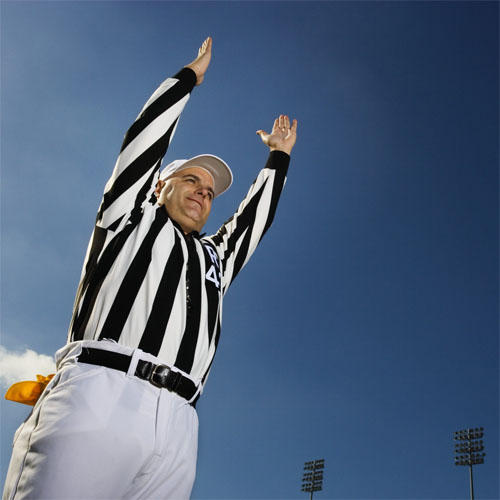
Football Official

Football Official
Name:Zebra
Location:Hackensack, NJ
Gender:M
Age:61
I've officiated football for over 30 years, now in my 25th on the college level. I've worked NCAA playoffs at the Division II and III level. In addition, I've coached at the scholastic level and have been an educator for over 35 years. I have no interest whatsoever in being an NFL official! Ever!
Subscribe to this Q&A | Sort by:
Q
Ignoring the blatant offensive pass interference, would you have made the same call as the refs in the SEA/GB game, or would you have ruled that a GB interception?
A

I HOPE I would have called for a conference!!

Communication is key between and among officials. When you watch the NFL or a good college crew officiate a game, you see them talk to each other. I'm not referring to the 4 or 5 man conferences that we all hate. I'm talking, as an example, about a linesman and a side judge conferring on a play at the pylon with "What did you see? Was he in, did he step out". Or two deep officials conferring over a catchable pass on a possible pass interference. Regardless, the key is to get it right. When you watch the replay from Monday night, you see the two officials look at each other - that's the good news. They should have been talking, saying something like "I've got an interception" and, as it appears, "I've got a touchdown". That's a concern!
...More

Q
Are there certain star players (past or current) who you think get special treatment from the refs?
A

Does Justin Verlander get a little larger strike zone than a rookie pitcher? Does Derek Jeter strike out looking very often? My answers to those questions are yes and no, respectively. And I think the answer to your question is likely yes in baseball (at least for balls and strikes) and perhaps basketball (does ANYONE travel any more?). Football? I doubt it.

In football. the action comes out you too fast to really be thinking whether the "star" is involved. It's also, in my opinion, too clear and open to see, even on judgement calls. The films show what happened and they are reviewed by supervisors. You're graded on each play; that doesn't happen in other sports. Play favorites with the stars? Not likely.

Q
Assuming most football refs are big fans themselves, do the leagues deliberately have refs officiate games where they have no allegiance to a team?
A

The NFL doesn't prohibit their officials from working their "home" team. I've seen NFL officials I know from the NYC area working the Jets' and Giants' games. I'm pretty sure that none of them have much, if any, Giants or Jets apparel in their wardrobe, or have a Facebook page with photos of them wearing it. However, if an NFL official has a relationship with someone on a specific team, they will not assign him to that team's games. For example, one official has a brother who coaches in Arizona, so he won't work their games. I do know that at the college level supervisors of officials will try to avoid assigning an official to a game if he is an alum. I am asked by my supervisor where I went to college and whether there are any issues with any other schools (e.g. a son or daughter attends ...More

Q
How much do you get paid to ref NCAA D-2?
A

The fee varies from conference to conference. Remember that at that level you don't have big TV contracts or high ticket prices supporting the athletic program. Fees should be higher (in my opinion) but schools pay what they can afford. Where I am in the northeast the game fee is $190.

Q
Do you think it's ok for NFL refs to play fantasy football?
A

Oooh, getting down and dirty with fun and games.

OK, I'll be frank - I can't figure the attraction of FF. That being said, I have a slew of friends and family who are in multiple fantasy leagues, some with entry fees in four figures. Not me.

Now, is it OK? I don't think so. Despite the fact that the NFL's vetting process for replacements was rather shaky (a professional poker player as a ref is not an issue? Really?) I don't think anyone in that situation should be involved in fantasy leagues or any form of gambling, legal or not. When you are put into a position of trust, as the protector of integrity in a very popular and financially lucrative endeavor (the NFL), you have to be above reproach. There can't be any questions about your character, your honesty, or your decisions.
...More

Q
Why do you say you wouldn’t want to be an NFL ref? Isn’t that a promotion to the highest level of your profession?
A

Fair question.

For whatever reason, I just never thought about the NFL. Many others do. I did want to do higher level NCAA games, but things happen -- being shorter doesn't always help. I've worked the former Division 1AA (now FCS) and that was great.

For some it comes down to the "big fish in a small pond" mindset. Why move up if I am getting great games and am respected for my work where I am currently? And there are other considerations that will keep people at a certain level: the impact of travel, family commitments, and the like.

There's an analogy used in the movie "The Right Stuff". The pyramid gets narrower towards the top. It gets tougher and tougher as you move "up"; sometimes it just doesn't seem all that important.

Q
Do you think the replacement refs ARE actually worse than the regular refs? Or are the coaches and players going overboard in trying to intimidate and incriminate them?
A

In the spirit of full disclosure, I know officials on both sides. I've worked with some at the high school and college level. I believe the replacements were put into a very difficult situation. They are officials - at some level - but are unfamiliar with the intricacies of NFL rules, the speed of the players at that level, and the nuances of what goes on at the line of scrimmage and downfield in the pro game. Like so many others have said, I think the replacements did the best job they could. I do feel that as the pre-season and then the regular season got underway, coaches and players saw what they could get away with (perhaps more than they could with the regulars) and pushed the envelope.

Q
How in-shape do you have to be to ref football effectively, and what's your regimen?
A

Once upon a time, in the world of football officials, the umpire (the one right behind the defensive line) used to be referred to as being in the "rocking chair". Just like an old man, he could sit back a rock on the front porch. He was often the heaviest and slowest on the field. Not any more.

The game, even on the high school level, is much faster and the players more athletic. The spread offense and no huddle teams are across the board. While you don't have to be ready to run a marathon, you'd better be able to move quickly and make judgements on the fly. An interception at the 1, run back 99 yards? You better be at the goal line pretty much with that defender, to call the TD!

I don't know of any physical testing at the high school level, but just about all college conferences
...More

Q
Is there a particular bad call you made that still haunts you to this day?
A

Oh no! True confessions. Haunt may be a strong word. Bother. Never forget. Shake your head in disbelief that I made that call. They may be better descriptors.

I think every official has made a call that he felt was right at the time but that when replaying it in his head later questions it. And we all cringe a bit when an observer comes in after the game and asks that wonderful question, "What did you see on that play?" Which in officials' circles means, "I can't wait to hear your explanation of THAT call".

The one play that I still shake my head about occurred probably a dozen years ago in a college game. I was having an off day. The first half was not going well for me and I was getting flustered. There was a pass into the endzone that clearly hit the ground before bouncing
...More

Q
Do you take players’ body language reactions into account? eg if 4 def. players IMMEDIATELY start waving their arms "incomplete", I say that's real evidence that you should take into acct. It's MUCH harder to fake immediate reactions than ppl think.
A

Defenders ALWAYS signal incomplete. Receivers ALWAYS signal catch. If they think they were held or interfered with, they ALWAYS wave their hands as if throwing the flag. They react very quickly, because they believe there was a foul. And there is the big difference between a player and an official. Officials don't BELIEVE there was a foul, they KNOW it. Four defenders waving their arms "incomplete" to me says four defenders blew their coverage.

Q
Do NCAA and NFL refs typically hold other jobs, also?
A

Yes. As far as I understand, the only major sport in the US that has "full-time" officials is baseball. While the salaries the NFL officials make is significant, they are employed full time elsewhere. They are lawyers, educators, finance people, and a host of other professionals. College officials, even in the highest level conferences, don't come close to the income of the NFL officials so they definitely have regular jobs.

Q
Why didn't the NFL just get NCAA D1 refs to fill in, given that they've probably officiated games of at least similar intensity, crowd size, etc?
A

That would make a lot of sense but it would have been a very dicey situation. Many of the D1 conferences use NFL officials as their supervisors of officials (e.g. Big East, Big 10, Big 12, C-USA). If the NFL used officials from those conferences, the officials would be replacing their own supervisors and their supervisors' colleagues on the NFL games. Can you say UGLY?

Q
Do you own up to bad calls after games?
A

More true confessions. This is an honesty, trust, and integrity thing.

Who am I owning up to? I can, and will, admit to my fellow officials that I blew a call, and not waiting until after the game. And truthfully, if you miss a call, you're going to hear it from the coach right then and there. That is when you own up to a bad judgement.

There are different situations regarding a "bad" call. An example: I had a game in which there was an interception by the team on my sideline - and right in front of the coach. The defender went up, caught the ball, and then came to the ground -- ALMOST. I thought I saw his knee hit and I blew the whistle. In replaying it in my head, I know he didn't touch, and he had clear sailing down the sideline to a score. But he wasn't scoring once I blew the
...More

Q
Do a coach's yells and pleas have any effect on a ref's decision-making? Or are you immune to it?
A

Regardless of the level of play, officials are human. We actually do have feelings, and no one enjoys getting yelled at. That being said, if you are really doing your job properly, you have to turn off the outside distractions, including coaches, players, and fans. And you'd better develop a thick skin and leave your emotions in the locker room. You have to try to be objective and "call what you see". Officials don't care (or shouldn't care) who wins or loses. Now, as a young official who is human (see first part of answer) can you be influenced? Sure. Are there "make up" calls? There shouldn't be. But as an official, a big part of your job is communication with the coach. You need to establish a relationship, especially the officials who work the sidelines, with the coach. He wants ...More

Q
The NFL refs' salaries are a rounding error compared to those of the athletes and the league's other operating costs. Why was the NFL so stubborn on this issue when it barely makes a dent in their bottom line?
A

This was, as I understand it, a simple management versus union matter. I heard, as I'm sure you did, that it would cost each team about $100,000 to settle it. The union wanted protections and the NFL wanted to make some significant changes in long term costs and control of the process of putting officials on the field. Roger Goodell set out an open letter to season ticket holders in which he wrote: "While the financial issues received the most attention, these negotiations were much more about long-term reforms. For example, beginning with the 2013 season, the NFL will have the option of hiring a number of officials on a full-time basis to work year-round, including on the field. In addition, the NFL will have the option to retain additional officials for training and development purposes, ...More

Q
All of the talking heads on TV were droning on about how much FASTER the NFL game is than other levels - how much truth is there to that? Is it really that much harder to officiate?
A

The talking heads love to talk. But some of them have bodies below those heads that actually played the game. And they're right.

Go to a local high school game and watch the players, not necessarily the game. Then go to a college game - doesn't have to be "big time" - and compare. Take that up one more level to the NFL and the difference is staggering.

I still work high school games, and I do it primarily with other college officials. It is, comparatively, much easier than doing a college game. Why? The skill, size, and speed of the players. There aren't many calls to be made in the average high school game that a decent official can't make. It gets a bit more challenging at the college level, and I'm only talking about D2 or 3.

I've also worked as a practice official for a nearby
...More

Q
I read this a.m. that NFL refs will make, on avg, $173K/yr starting 2013. Am I missing something, or does that seem insanely high for like 20 days of actual work? Or is there a lot more work that goes on behind-the-scenes?
A

It always comes down to money.

What is anyone worth for their labor? Is A-Rod worth $240 million? Is any performer worth the money they get for a movie or a concert? What will the traffic bear?

As you watched the first three weeks of the NFL season, I'm sure there were a few times when you thought that whatever the NFL paid the regular refs wasn't enough. The big questions here, and in any profession, is what is your expertise, your skill, your time worth?

Your question notes 20 days of work. Well, it's a bit more than that. As an educator, I would get similar comments like 'you only work 10 months' and you only work from 9 to 3. Not exactly. Go to the answers on this site about teachers. The woman writing does a good job explaining the hours/days that teachers put in well beyond
...More

Q
How many bad calls does it take before a college or pro ref gets fired?
A

One of the issues in the NFL lockout involved adding crews. The reason was that the commissioner wanted to be able to have the extra bodies to replace "under-performing" officials during the season.

The number of "bad calls" isn't a black-and-white matter; it's a lot more complex than that. Officials at the higher levels are judged on a range of actions including correct calls, correct judgements, incorrect judgements, incorrect calls. It also takes into account working with the crew, communicating with coaches, and test scores, among other things. I don't believe a supervisor has a set number in mind when he critiques an official. So there isn't a number of "bad calls" that decides an official's fate.

Q
How can the NFL say unequivocally “Golden Tate should have been called for offensive pass interference, which should have ended the game”, and not reverse the game result? Has the NCAA ever reversed the actual result of a game after the fact?
A

To the best of my knowledge, that has never happened. And I don't think it should. If you open that can of worms and set a precedent for changing results after the fact from what occurred on the field, there would be no end to the challenges. It would call into question every decision, every call, every outcome. The old saw goes, 'It's a game played by humans and judged by humans'. You have to live with certain things. And as a side note, the official who made the call apparently is publicly saying he was right. Heard that on the radio this morning.

Q
Do you think there should be some equivalent of a technical foul, like in basketball? You guys seem to take an awful lot of abuse without really being able to do anything about it.
A

Well, if you judge abuse by what the replacement refs were taking, then yes, we take a lot.

But look at baseball. Kicking dirt, going nose-to-nose with an umpire. I know coaches/managers can be ejected, but umpires take a lot, probably more than in any sport.

A lot of this goes back to communication and control. You need to communicate with the coach about what is going on. They have a job to do and so does the official. The coaches will say a lot, usually about a missed call. But eventually they have to coach. Sometimes they'll keep going and then communicating with them is the key. "Coach, I'll watch for that", or "Coach, I'll find out what the other official saw as soon as I can". If they keep harping, the best thing to say is something like, "Coach, I know you're upset, but
...More

Q
Do players or coaches physically threaten you? Have you ever actually been worried about them following through?
A

The simple answer is no. I think I can honestly say that I have never been or felt threatened on the field. There was a college coach who once violated the "unwritten" rules and confronted us after the game in the locker room. I guess he figured it was our fault that his team blew a two touchdown lead in the fourth quarter. In that situation, we maintained our calm as best we could, left the campus quickly, and contacted our supervisor. That, however, was a single occurrence and I never experienced anything like that again.

There has been only one time in my career where I received a police escort off the field. It was a high school game and there were back-to-back defensive pass interference calls against the home team. It allowed the visitors to kick the game winning field goal with
...More

Q
If refs absolutely cannot agree on a call no matter how much they review a play, what happens then?
A

Uhh, you do agree. There are no "do overs" because officials can't agree. And when push comes to shove, that is why the white hat is there.

There will be plays (need I remind you of Seattle-Green Bay) where two officials see it differently (e.g. catch-no catch on a pass that is close to the ground). You confer. Someone has to convince the other. And, as I said, the referee is there to mediate and guide the discussion. On a pass play, for example, the college axiom is 'when in doubt, wipe it out'. But that assumes there is no replay (it's not available at Division II or III) or that there is no clear opinion from both officials. Be assured, there will be a decision.

Q
Do you think the replacement ref debacle in the NFL gave comfort to refs in other major sports about their own job security cuz they're now thinking "my league will never risk a PR disaster like that, so we've got more leverage now"?
A

Good question and very interesting. There is no question that the Monday night game with the controversial ending was a catalyst to get the deal done. But I think the NFL was in a unique position. It is, with some contrary notions, the most popular sport. There is heavy gambling on the NFL (not that the league "worries" about Las Vegas books), so it garners a lot of attention. But not every call made during the lockout was in error. And not every replacement official was bad or didn't belong at that level. You can find very competent replacements - the NFL, as I noted in another posting, did not use highly competent Division 1 officials who MIGHT have done a better job. If the NHL locked out its officials, what kind of outcry would there be? With all due respect to hockey fans everywhere, ...More

Q
How do I get into officiating? I love baseball, but realistically I’m never going to play in the majors, but being an umpire is like my dream job.
A

A couple of thoughts. First, I believe that most officials start out in officiating because they love the sport. You're on the right track. As for how to get started, often local officiating organizations put ads or list meetings in the sports section or in public notices in the paper. Another way is to contact your state's sports governing body to get the name/address/phone of the secretary of the officials group. Contact them for an application or to find out about the process. If you happen to be in season, go to a local high school game and talk to the umpires. That, for the record, is how I got into football officiating.

Q
Do you find yourself acting as a referee OFF the field? Meaning, are you the natural mediator when it comes to arguments between friends, family, etc?
A

I don't get paid enough to mediate my family's problems. I don't get paid enough to officiate football, either, but I WANT to be there.

Q
What changes would you make to NFL instant replay if you had free reign?
A

It seems that every time you have a controversial call, you learn some other wrinkle about instant replay (they can't review this or that). I've never worked with instant replay, although I know a lot of officials who like it because they know the call will be corrected. Odd, you say, that they are okay with that? Bottom line is, officials want the call to be right, so they know that if a call is tenuous, it will be corrected.

What would I want changed? I'm really not sure. I think a lot is going right, recent activity not withstanding. Sometimes I think they've gone too far with things like catches (having to maintain possession throughout the entire action - the only way you could possibly see it is with super-slow motion replay - takes away the human element). I'm probably not giving
...More

Q
Have you ever been offered a bribe to favor a team in a game you were reffing?
A

No. And if I was offered, I certainly hope I would have the character and integrity to say no. And then to turn the person in to the appropriate authorities.

Q
Do refs ever have off-the-field friendships/relationships with coaches? Or is that an absolute no-no?
A

As with any occupation, you get to know people, and you might actually be friends outside of work. That being said, I'd say it is a bit harder to do, and probably less likely, on the college and professional level.

When I started doing high school officiating, I was also in education. I knew coaches from teaching and even coaching other sports (as I did), and you tended to work in the same area so you saw them more frequently. On the college level, and certainly in the NFL, you travel a lot to get to your games, and coaches change jobs moving to other areas. It is far less likely that you would be socializing with a coach.

Q
Do you ever experience any significant ref-on-ref friction? Like if you and another ref just have very different outlooks on what constitutes fairness etc?
A

While for most of this is an avocation, it is no different than any other job. You are going to have "professional differences". Your example of "fairness" might not be the right example, but there will be officials who have different views of holding or pass interference. Some sideline officials will give a coach a bit more leeway in comments or "dialogue" about a call than others. If you are on a crew, you try to be as consistent as you can, That's why, on the college level, we get there three or more hours before a game so we can review the little things that make the game run well. If there are serious issues - and I'm probably talking personality more than actual officiating - it needs to be addressed (the referee - the white hat - needs to intervene) and that might mean moving someone ...More

Q
Are refs given "scripts" for announcing calls to the crowd, or are you free to phrase a call however you wish?
A

Short answer: no. Referees have to know the rules, the enforcement, and need to have the ability to speak clearly and extemporaneously. Every situation is a bit different so you can't have a script. The easy stuff is natural: "Holding, on the offense, number 75. Ten yard penalty, repeat second down". But you can get a bit involved, too. "We have multiple fouls on the receiving team on the return. Block in the back, number 29; that foul is declined. Holding, number 43. That foul is enforced at the spot of the foul. First down." You can't script all that.

There are some things that supervisors want and don't want said in the announcements. For example, with the current concern about concussions, there are more fouls for helmet-to-helmet contact. But you shouldn't be hearing the phrase
...More

Q
Do players ever accuse you or your colleagues of being racist when a call doesn't go their way?
A

Football is an emotional game, and things get said in the heat of the moment. Interestingly, and I would add fortunately and happily, such situations are very rare. Will kids think that, based on their own histories and backgrounds? Maybe. But coaches can stop that sort of thing, and we, as officials, can diffuse it, too. How we interact with the players can let them know that such comments are a) inappropriate and b) a bit misguided.

There are far more minorities - and women! - in officiating across the board, including football. The NFL had a woman as a replacement and I am aware of another who is in line for a spot down the road.

Q
If it were up to you, would you put an end to endzone celebrations, or do you think this is something the NFL should be more lenient about?
A

Guess I'm old school. I'm a big believer in the axiom, "Act like you've been there before". Everyone is trying to get on Sports Center.

It is a bit silly. Personally, yes, cut the nonsense. I don't think it takes away from the college game to have some "youthful exuberance" but eliminate celebrations that draw attention to you. , Why have all the carrying on as the pros do now? The college rule changed so that any sort of unsportsmanlike act (high-stepping into the end zone, for example) causes the foul to be live, meaning no score and the foul is enforced from the spot - maybe the 5 or 10=yards line. That might stop some fools from spiking the ball on the 5 yard line by mistake. Cutting back on celebrations also might stop guys from trying to dunk over the cross bar and breaking
...More

Q
Do female football refs have a markedly harder time earning the respect of male refs and players, or are we past that point?
A

That's a great question with answers on a lot of levels. I have worked with a female official on the high school level. She was knowledgeable and she hustled. You can't ask for much more than that.

One of the issues that creeps into the conversation, though, is a person's knowledge level and their "feel" for the game. If you never played it, can you understand it? The answer is, of course, yes; you just have to work harder at it. I know a male official who said he was a better lacrosse official because he never played the game; he had to study and think more. He couldn't assume he knew the game "because he played it" as he did in football. I believe women are in the same situation.

Today, there is more equity and both players and coaches, being younger, have different, more open
...More

Q
Do you think someone who's never really played organized football (beyond Pop Warner leagues) can still be a good ref at the college or pro level, assuming he knows the rulebook backward and forward?
A

I think the answer is yes, with this caveat: You really need to work at it. That may seem obvious, but having played a sport, you have a "feel" for how it works and flows. Knowing the rules, mechanics, and philosophies is an absolute, whether you played the game or not. Applying them, interpreting them, that's where you need to work. It's like the law: there is the letter of the law (what the legislature created) and there is the spirit of the law (how it is interpreted and applied by the police and the courts). I believe you would need to be a true student of the game in order to do the job well, and that would take some time. In an earlier post, I noted that I knew an official who does both football and lacrosse. He felt he was a better lacrosse official because he didn't play the ...More

Q
When do football refs typically retire? How old were the oldest refs you've worked with?
A

Does the phrase "drag them off kicking and screaming" sound familiar? To answer the second question first, I worked with a guy who was 72 when he left the field. He was still doing Division 2 and 3 college ball. He was sharp, in great shape, and he was just plain good. But it was time. And I guess that's the best answer; each official knows when it is time to step down. It is very much like retiring from your regular job - when is the right time? But doing this is a labor of love...and a little glory and ego. And I would say that in a lot of cases it is the camaraderie and bonding with fellow officials that keeps people on the field. And you don't want to give that up easily. On average, I would say that most high school and college officials step down in their late ...More

Q
Can refs get fined or penalized for making bad calls?
A

In the NFL, as well as all the major college conferences, officials are evaluated on every game. They are graded on good calls, poor calls, good no-calls, and bad no-calls. Those evaluations go into their ranking and, ultimately, into their promotion, retention, or release. In the case of egregious mistakes (e.g. giving a team a fifth down, blatantly mis-enforcing or interpreting a rule) an official -- or even an entire crew -- could be suspended or lose game assignments. Since that means no paycheck, I guess you could say they do get "fined".

Q
How does the NFL decide who gets to ref the Super Bowl? Is it purely seniority, or are the refs "ranked" in some way?
A

Appropriate that there would be a question on the eve of Super Bowl XLVII. There is sooooo much on the line in these contests that the NFL - any league and even the college conferences - has to have its best on the job. There are rankings and the best get to the top games. As I understand it, though, there is a rotation among the top officials so that the same referee (white hat) or other positions don't get the game every year. I mentioned the colleges. In one conference, for example, crews are assigned games up until the closing few weeks when games are more critical in deciding championships. For those late games, merit is the criteria for assigning the officials.

Q
Why do football referees have numbers on their jerseys?
A

It's a simple identification process. Granted, the NFL has a pretty limited number of officials, but the idea is to accurately identify who is making the call. It isn't done on the college level or the high school level. There are numbers used in other sports, e.g. In New Jersey, high school wrestling officials have identifying numbers.

Q
Can football referees wear glasses?
A

If they want to see, it's a big help. Seriously, yes. Whether they wear glasses or contacts, the important thing is they see the game properly. I wear glasses and, on average, I would say that maybe half the people I work with wear corrective lenses in some form. Years ago, while working high school, I had a pair of photo-grey glasses that changed to dark lenses in the sun. One day, a fan wasn't totally enthralled with my call and yelled out, 'Take off your sunglasses, you'll see the game a lot better'. I hadn't even thought about it until then. Needless to say, the next game those glasses stayed home.

Q
If a QB throws the ball out of bounds "throwing the ball away" from their own endzone, is that intentional grounding (where a safety would be awarded to the other team) or just an incomplete pass?
A

This question appeared back in November but, unfortunately, I didn't get notified that it was here. I'm seeing it now the day before the Super Bowl. Can it be intentional grounding? Yes, and if it is then it is a safety (it's a "spot foul", meaning it is marked off from the spot of the infraction). But just as on any other part of the field, the QB can throw it away under certain circumstances (e.g. out of the pocket) and it goes as in incomplete pass.