
Rndballref
20 Years Experience
Chicago, IL
Male, 60
For twenty years I officiated high school, AAU and park district basketball games, retiring recently. For a few officiating is the focus of their occupation, while for most working as an umpire or basketball referee is an avocation. I started ref'ing to earn beer money during college, but it became a great way to stay connected to the best sports game in the universe. As a spinoff, I wrote a sports-thriller novel loosely based on my referee experiences titled, Advantage Disadvantage
The act of boxing out is properly executed when you occupy spaces on the floor by moving your feet and obtaining the verical rights to a space before your opponent can legally obtain that space. Proper technique might include "sizing up the opponent" behind you (that is with light contact feeling where and when the opponent might try to get around you), and moving your feet to "block" him out from moving closer to the basket, most typically on a rebound. When you block out, you do not have the right to stick your rear end out and dislodge a player behind you. Good refs will call a foul on the inside player for dislodging the player behind him, AND the same ref should call a foul on a player who pushes an opponent under the basket out of contention for a rebound. Good defense, like proper rebounding is played with your feet (just my opinion).
I worked a summer league several years ago and for the first half of a couple games the coach made the players on defense lock their arms behind their backs. They could not steal, swat or defend with their hands. So what con you do? MOVE YOUR FEET and try to legally deny offensive players spots on the floor. Only when a shot went up could the players use their hands. The players were certainly frustrated but it forced moving their feet.
Share Answer: 

In NFHS there are players fouled in the act of shooting, common fouls, player control fouls, team control fouls and technical fouls. A player attempting to tip the basketball into the hoop is fouled in the act of shooting and will get 2 free throws, unless the ball went in - the bucket counts plus 1 free throw.
It has to be this way because if it was considered a common foul (and assume the team is in the bonus) and the ball went in, then you would have to count the basket and award a one and one - which would be crazy and severe.
Share Answer: 
Yes it matters. On sideline throw-ins, the referee inbounding the ball should between the player and the opponent's basket, so the ref is behind the most likely foreward movement of the play.
In 2 man officiating the referees are to be opposite of each other and the throw in will occur to the inside of the ref.
In 3 man crew, I have worked with some officials who position themselves between the basket and the throw in player on the baseline, but I think this positioning should only be used when the throw in on the baseline is near the sideline.
These postions have developed out of the objective to put the ref in the best possible position to see the play. That is why referees are allowed to bounce the ball to the throw in player - you get to stand back and have a wider view.
These practices seem picky but doing them correctly is pre-requisite for advancing. The evaluators I have encountered expect spot on mechanics. Being out of position on a throw would lower your rating.
Share Answer: 
In high school ball (and even college) the girls game is played below the rim. So, there is generally more passing and bombing away compared to the boy's game. Having said that, there is an unmistakable trend in the girl's game where the guards can handle the ball and are skilled enough to penetrate the lane and dish. In my view, the most boring basketball (boys, girls, mens or women) is when they dump the ball into the post and watch a turnaround jump shot by tall players. If you lower the girl's rim (ring as the rule book calls it), I'm afraid you will encourage more rough post play. Just my opinion though, because there are plenty of people who loved watching Shaq play.
Share Answer: 
Special Education Teacher
 How come it often takes years to figure out that a kid is dyslexic?
Former IRS Revenue Officer
 Did you ever deal with people who tried the 'Wesley Snipes' defense?
Car Salesman
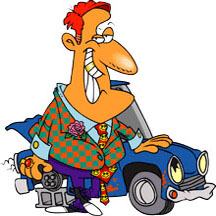 Are women more likely to get taken advantage of when buying a car?
Parents are the problem with youth sports. I have had more parents removed from games than players and coaches combined. Here's an irony: freshman games are harder to call than varsity, because unless you want to ruin the game completely in underclass games you are deciding when not to blow the whistle. in varsity games you call mostly what you see. Yet, as you progress and hone the referee craft you work less underclass games. So inevitably in a blowout freshman game a player is mildy fouled while dribbling going east and west near the half court line. The dribbler maintains control of the ball, but you are trying to keep the game moving. The freshman's father stands up screaming for a foul, because he wants his 3rd string kid to shoot a free throw to get it on tape and in the record book. There is a learning curve for fans as well - varsity parents are generally better. One of my peers was once attacked at halftime by a freshman player's grandfather.
Share Answer: 
A good resource is the Illinois High School Association's website. It publishes online a list of officials' associations. Every official must belong to an association and each association maintains lists of members. In addition, most associations have an assignment chairman whose function is to help member officials get bookings. www.ihsa.org
You can also call local park districts and ask who books their officials. There are a few guys who run businesses which hire referees for games, and often the park districts hire them to supply officials.
Share Answer: 
The rule is clear and everyone in the gym knows a foul is coming. It is a real dilemma. An intentional foul has a very severe penalty, but calling a common foul seems against the rule. This can only be fixed by a rule change - perhaps the fouled team gets a choice of free throws OR the ball. It is the coward's way out but I don't see a solution.
Share Answer: 
-OR-
 Login with Facebook
 (max 20 characters - letters, numbers, and underscores only. Note that your username is private, and you have the option to choose an alias when asking questions or hosting a Q&A.)
(A valid e-mail address is required. Your e-mail will not be shared with anyone.)
(min 5 characters)
By checking this box, you acknowledge that you have read and agree to Jobstr.com’s Terms and Privacy Policy.
-OR-
Register with Facebook(Don't worry: you'll be able to choose an alias when asking questions or hosting a Q&A.)



 Browse Jobs
 Host a Q&A
 Search

 Submit Your Question
 Host a Q&A
 Last 7

